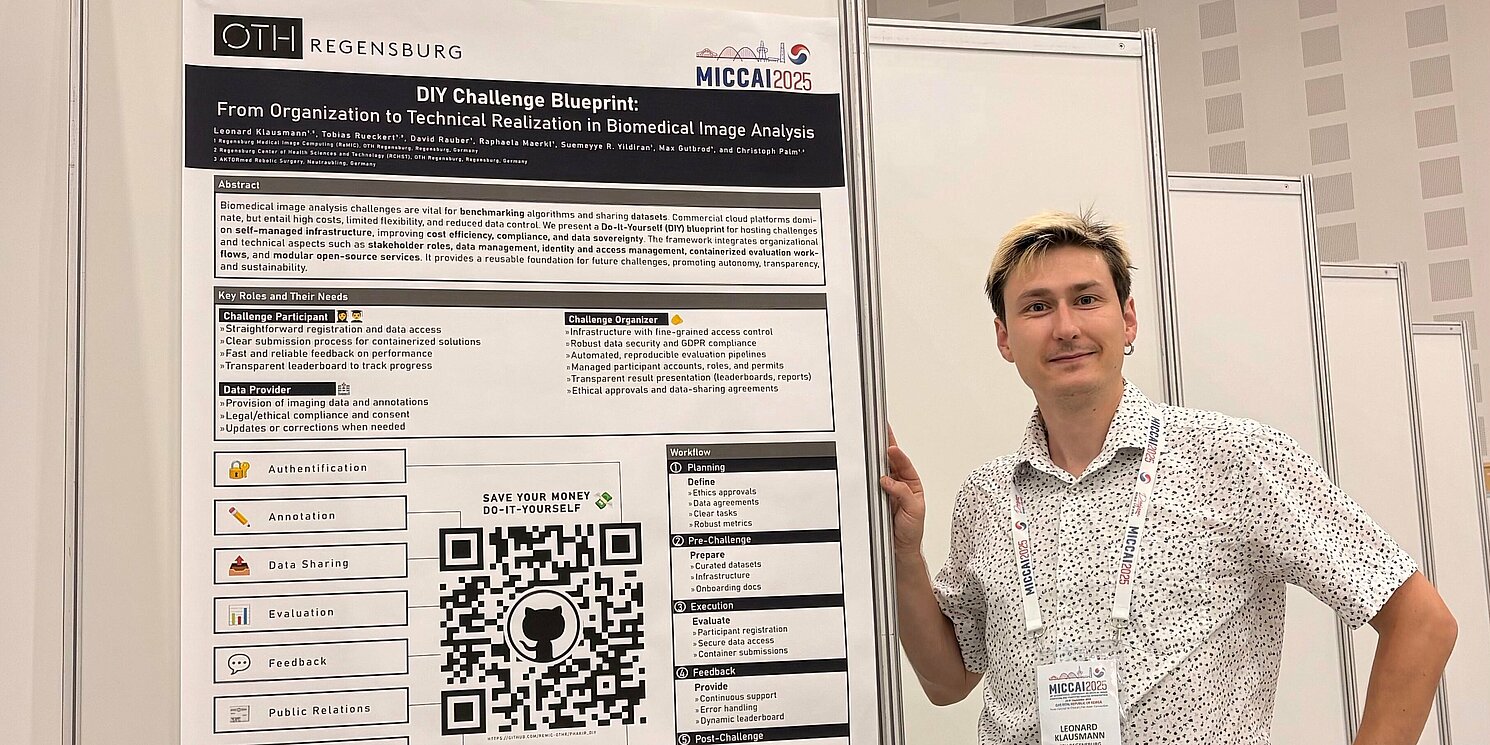
At MICCAI 2025 in Daejeon, South Korea, Leonard Klausmann presented the work on Do-It-Yourself Infrastructures for Biomedical Image Analysis Challenges on Friday, 26 September.
Biomedical challenges have established themselves as a standard for publishing new data sets and making algorithms comparable. However, these are often organised via commercial cloud platforms, which can lead to restrictions in terms of flexibility, costs and data control.
The presented concept describes a blueprint for self-hosted challenge platforms based on a modular, containerised
- modular, containerised Docker architecture,
- open source identity management and
- automated workflows for solution evaluation
. The aim is to create a cost-efficient, data-sovereign and GDPR-compliant infrastructure that can be operated reliably and securely.
The PhaKIR Challenge was presented as a proof of concept at MICCAI 2024, where international teams were able to successfully submit and validate their solutions via the self-hosted platform. This reference implementation with guidelines is freely available on Github. The benefit for the community was considered so high that the MICCAI paper was rated particularly highly and received an early accept.
Leonard Klausmann, technical officer of the RCBE and RCHST and PhD student at the PZAI, was responsible for the conceptualisation and implementation of the PhaKIR Challenge platform. The PhaKIR Challenge itself was a team effort by ReMIC @ OTH Regensburg under the leadership of Tobias Rückert in collaboration with David Rauber, Raphaela Märkl, Sümeyye R. Yildiran, Max Gutbrod and Christoph Palm.